Saturday, June 30, 2007

Creation, eh?


I spent from Weds. evening to Fri. morning at Creation with my dad, Aunt Barb, and cousins Wendy and Donna, who hail from Saskatoon, Saskatchewan (about 4 hours north of North Dakota). As you can see, Canadian pride ran high =)


What Creation is: well over 30,000 people who camp in a field in central PA for 4 days to listen to over 30 bands and a wide range of speakers. Highlights for me this year were David Crowder Band and speaker Duffy Robbins (from Eastern!) who spoke about the utter irrationality of passionate love, using the example of his dad, who cared for his mom for 10 years after she was diagnosed with Ahleizmer's. Also fun was the thunderstorm Weds. night and the s'more I made while it was raining!

At right is my dad, Donna, Wendy, me, and Aunt Barb at Lookout Point, from which you can see the main stage and the vast sprawl of campers.

Tuesday, June 26, 2007

Locks of love


This morning I finally did it - I got 10 inches of hair cut off to donate to Locks of Love, a non-profit organization that uses donated hair to create wigs for children who have lost their hair. Most recipients of Locks of Love suffer from either cancer or alopecia areata, an auto-immune disease that causes hair follicles to shut down. Currently, about 4.7 million people in the US have alopecia areata, although the amount of hair loss varies from person to person.

Locks of Love uses about 6 to 10 ponytails of hair to make each hairpiece (known in technical lingo as a prostheses) that would fetch a price of $3500 - $6000 retail. Each recipient of a protheses has a mold made of their head to ensure a snug fit, and the protheses attaches to the head with a strong vacuum seal that can only be broken by the wearer.

Find out more about Locks of Love and how to donate your hair at: http://www.locksoflove.org/index.html

(On a more personal note, I think I understand better why many religious orders cut entering nuns' hair as one of the final steps in their journey to full membership in the community, because I have to confess that as the scissors came closer and closer to my head, I felt a stronger attraction to my tresses than I had expected! I knew the cut was for a good cause, but what would I look like without long hair? Vanity whispers and is fought at the most unexpected places.)

Sunday, June 24, 2007

Friends don't let friends discern alone

June 24 - Solemnity of the Birth of St. John the Baptist.


It is a well-known story: Zechariah and Elizabeth are past their childbearing years, and so when an angel appears to Zechariah in the temple and announces that Elizabeth will have a son named John, he responds with skepticism. In exchange for his doubt, he is struck speechless, until Elizabeth indeed gives birth to he who will be a messenger of Christ. Zechariah, whose doubt shriveled as his wife's belly grew large with this inconceivable child, declares after nine silent months that the baby boy will be named John. "Immediately," writes Luke, "his mouth was opened, his tongue freed, and he spoke blessing God." (1:64) Zechariah sings the beautiful Benedictus, declaring that his child will be the herald of the breaking day, of the light that will "shine on those who sit in darkness and death's shadow, to guide our feet into the path of peace." (1:79)

In his homily this morning, Fr. Snyder spoke eloquently on the response of Zechariah's countrymen to the bizarre events surrounding John's birth. As the news spread, "all who heard these things took them to heart, saying, 'What, then, will this child be?'" (1:66)

They took these things to heart, just as Mary six months later would reflect on her own astonishing circumstances, as the mother of a baby whose coming was greeted by angels. Fr. Snyder explained that when contempories of Mary and Elizabeth promised, "I'll think that over," they gestured to their heart, not to their head. To take events in our lives to heart, as Mary and Zechariah's neighbors did, is to contemplate their significance and discern the gentle whisper of God in the events that carry us across the calendar pages.

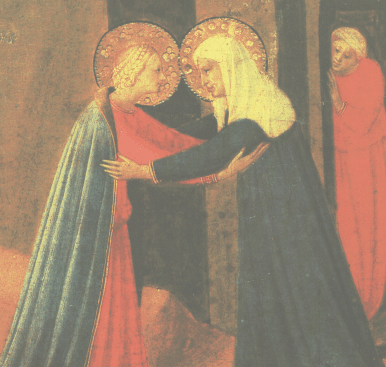
How do we 'take things to heart,' and understand more fully the meaning of both incredible and everday occurances? Fr. Snyder encouraged times of silence and solitude, as well as journaling. But he also called to mind the meeting of Mary and Elizabeth when both were pregnant, a rendezvous known as the Visitation. As these two women grasped hands and breathlessly exclaimed their wonder at the promised children within them, they helped each other to rejoice in such unexpected events, and to find courage and wisdom to proceed into an unknown future.

"Discernment," says Practicing Our Faith, "is the intentional practice by which a community or an individual seeks, recognizes, and intentionally takes part in the activity of God in concrete situations." In order to discern, it is good to be alone, to seek further understanding in the desert where external distractions are kept to a minimum. But, as Fr. Snyder so wisely pointed out, it is also good to be together, to share the various dreams and contours of our present lives with our friends so that we can help each other rejoice at what the Lord is doing in our midst, and to see more clearly what path we should take.

As a young woman currently discerning what profession or vocation to commit to, I took great courage from Fr. Snyder's homily. One's vocation is personal in the deepest sense of the word, belonging in all its particularity to one human being, but the act of discovering and living that vocation is, as the Visitation shows us, thoroughly shared. What excitement it is to walk each day alongside persons still being formed into who they were created to be! May we, like the onlookers of John the Baptist's birth, take what we see and hear to heart, pondering together the actions of God in our lives.

Saturday, June 23, 2007

A Hymn to encourage our labors...

...even Saturday morning yard work.

Lord, whose love in humble service bore the weight of human need,
Who did on the Cross, foresaken, show us mercy's perfect deed:
We, your servants, bring the worship not of voice alone, but heart;
Consecrating to your purpose every gift which you impart.

As we worship, grant us vision, till your love's revealing light,
Till the height and depth and greatness dawns upon our human sight;
Making know the needs and burdens your compassion bids us bear,
Stirring us to faithful service, your abundant life to share.

Called from worship into service, forth in your great name we go:
To the child, the youth, the aged, love in living deeds to show.
Hope and health, goodwill and comfort, counsel, aid, and peace we give,
That your children, Lord, in freedom, may your mercy know, and live.

- Text by Albert Bayly, Traditional Dutch Melody

Wednesday, June 20, 2007

Shopping, green style

(This post was published as a Letter to the Editor in the Harrisburg Patriot News on Thursday, June 14.)

As the top international leaders convened for the G8 summit, with global warming high on their agendy, it's a fine time to assess our daily habits and prune any excess use of non-renewable resources. Here's one disarmingly simple idea: when shopping, bring reusable bags instead of accumulating more and more plastic bags that in all likelihood will end up in the trash.

I currently work as a cashier for Kmart, and I could count on exactly one finger the number of people I've observed using a canvas bag for their purchases instead of plastic. Don't worry: your receipt is proof of purchase, not a plastic bag, which could be easily smuggled in anyway. Plus, an added bonus: canvas or cloth bags are sturdier and often more comfortable to carry than plastic.

Decisions such as how to transport your groceries may seem, in the face of doomsday global warming predictions, like cleaning a skyscraper with a toothbrush. However, sustainable and Earth-friendly habits (like reusing shopping bags) are the vertebrae of a culture that values global health more than convenience.

Our Lady of the Copier

I admit it: I hope to change the world. Perhaps other recent college grads fantasize about a plush corner office, but my dreams have been molded by the anthems of bravery and vocation proclaimed by the late Pope John Paul.

After spending eight months last year in Central America, the visions of my world-changing life have featured me, smiling calmly, confidently negotiating a fairer wage for banana workers in Costa Rica. Or me, patiently explaining the nuances of English relative-adverb clauses to a group of immigrants who bob their variously colored heads up and down with gratitude.

Because of such dreams, last semester I hopped on the local train every Thursday morning and traveled from my suburban college to a poor Philadelphian neighborhood. I disembarked at the Welcome Center, an immigrant ministry run by the Sisters of St. Joseph. It is a place inundated with love and service. Even the artwork at the Center, culled from the far reaches of the globe, silently speaks of a family bound together by common humanity. “This is exactly,” I mused, “how I would decorate such an organization.”

At the Center, my daydreams became more concrete; there I was, guiding a young Polish girl in her typing until her fingers danced over the keys; and there I was, using a beautiful Guatemalan weaving to explain the color words in English.

My first morning of volunteering, I arrived plumb full of eagerness. “Here I am!” I announced to Sister Judy, glancing around for immigrants to win over with a kind smile and simple sentences. “Put me to work!” And indeed she did; for the next four hours, I affixed labels to Valentine’s Day treats, I alphabetically arranged out-going mail, but most of all I developed a wary working relationship with the savviest yet most infuriating machine known to man, namely, the copier. I copied page after page of ESL books, exposing their contents to the gray monstrosity’s sleek belly and receiving in return fresh warm clones. Double-sided, check. Twelve copies, check. Sort and order, check.

The whole morning, along with negotiating paper jams and bizarrely-worded messages from the copier, I wrestled pride in all its sneaky guises. You got up at 7 for this? it whispered. Don’t they know how talented you are with languages? How good you are at making people feel welcome? Flailing for a response and not finding one, I glanced up from my work and noticed, above me on the wall, the Virgin of Guadalupe. She gazed down at the copier serenely, as if she were devoted to protect it from the hazards of electrical surges and paper jams.

A tiny task, sniffed pride. The Blessed Mother countered with a patient, almost amused smile, as if to say, “Peace. I am not the judge of a task’s worthiness, merely the handmaid of He who works in me in ways great and small.”

I thought of the Virgin in the stable at Bethlehem, in the hours after she posed for Christmas cards. What menial tasks occupied her, like fetching water, preparing a bed in the hay for her Son, and feeding the Bread of life? How mundane they must have seemed to an observer, just another mother enacting the same life rituals carried out since Eve and her babies. And yet Mary pondered a secret while nursing; her Son was the hoped-for fulfillment of the Promise, and every task geared toward Him was mysteriously enveloped into the one mission of the Redeemer, the Sanctifier of all things mundane.

So it was, and so it is. As I stood there duplicating pages and tussling with glory-hungry pride, Our Lady of the Copier gently reminded me of the premium her Son places on the tiny and forgotten tasks. As another great woman once said, there are no great tasks, but only small tasks done with great love. I do not rescind my dreams to change the world, but I pray for deeper humility to believe that even copying, stapling, and alphabetizing, when done with great love, bear much fruit in the Kingdom. Our Lady of the Copier, mistress of humility, pray for us would-be saviors.